The Great Local Disconnect: Why a Five-Month-High Rand Isn't Igniting the JSE
Lismore Burke
August 14, 2026
There have been some remarkable divergences in the South African markets over the last two weeks. The Rand has appreciated to R16.13 per dollar, the highest in more than five months, before easing to trade around R16.19. However, the FTSE/JSE All Share Index is declining from its recent high peak. A tactical question arises for next week: why haven't the positive sentiment towards risk assets and the weaker US dollar boosted domestic equities?
The
FX Rally: A Dollar and Yield Story, not a Local One
The rand's resilience has little to do with any improvement in South African
fundamentals. It's a function of U.S. monetary policy cooling faster than
expected. The July inflation report for the United States came in a moderate
0.1%, after weaker-than-expected non-farm payrolls, which collectively priced
out any possibility of Fed tightening rates aggressively and weakened the
dollar in the process. This, in turn, prompted foreign funds to chase yield,
and South African government securities have been among the biggest
beneficiaries: foreign buyers of government securities bought up R23.1 billion
worth ($1.43 billion) of South African government securities in the first week
of August alone, which marked the largest such flow since January. With local
ten-year bond yields at 8.41% to 8.57%, and with implied volatility trading
below realized volatility, South Africa has emerged as one of the better
dollar-carry trade opportunities in emerging markets. To summarize, the rand
currently trades not so much as an emerging-market currency but rather as a
high-yielding proxy to a weakening dollar.
Why the JSE Isn't
Following
If
foreign capital is pouring into South African debt, the natural assumption is
that equities would rise alongside it. Three factors explain why that hasn't
happened.
The
rand-hedge penalty. The
ALSI is heavily weighted toward global mega-caps and resource giants, Naspers,
Prosus, luxury conglomerates, and major miners among them, that earn the bulk
of their revenue in dollars, euros, or renminbi. When the rand appreciates by
roughly 5%, that foreign-currency income translates into fewer rand on the
balance sheet, which mechanically pressures these companies' share prices even
when nothing about their underlying business has changed.
Mining
and industrial drag.
June mining production data showed a 4.0% year-on-year contraction, and
elevated input costs alongside softer commodity prices continue to squeeze
margins for local miners, offsetting whatever tailwind the broader macro
picture provides.
A domestic growth lag. Bond markets reward high interest-rate
differentials; equity markets reward real economic expansion, and South Africa
isn't currently offering much of the latter. Statistics South Africa's most
recent unemployment figure of 33.6% underscores the structural headwinds facing
consumer-facing sectors like retail and domestic industrials, even with a
stronger currency easing import costs.
Put
together, currency strength is flowing through the bond market first, and the
rand's recent gains have been enough to hurt globally earning equities without
yet being matched by the domestic growth story that would lift the rest of the
index.
Figure 1: Purple (JSE Top 40), Blue (USD/ZAR), Green (SA 10Y Yield), Trading ViewFigure 2: USDZAR, Daily, Trading View
Having fallen sharply off its peak of
17.2258, driven by geopolitics, the pair is currently probing a significant
macro support area ranging between 16.0000 and 16.1800.
The recent sell-off was accelerated by a
price breakdown below the previous pivot support level of 16.6097 and was
supported by a dovish Federal Reserve and heavy bond purchases by foreign
investors.
Key Support Level: A break below the support area of 16.0000 and 16.1800 would open
the way for further weakness towards 15.80- 15.60, an important structural
support that was formed during the commodity super cycle.
Resistance
Levels: Any rally would
face initial resistance at 16.6097, followed by further resistance at 16.9178
and the recent peak of 17.2258.
Bottom line:
The 16.00–16.20 zone on USD/ZAR is not just technical support. The market
attempts to price whether South Africa's improving fundamentals can hold their
ground if the Fed's dovish pivot stalls or if oil shocks reignite. The bond
market is betting yes. The equity market is not yet convinced.
Disclaimer: The content published above has been prepared by CFI for informational purposes only and should not be considered as investment advice. Any view expressed does not constitute a personal recommendation or solicitation to buy or sell. The information provided does not have regard to the specific investment objectives, financial situation, and needs of any specific person who may receive it, and is not held out as independent investment research and may have been acted upon by persons connected with CFI. Market data is derived from independent sources believed to be reliable, however, CFI makes no guarantee of its accuracy or completeness, and accepts no responsibility for any consequence of its use by recipients.






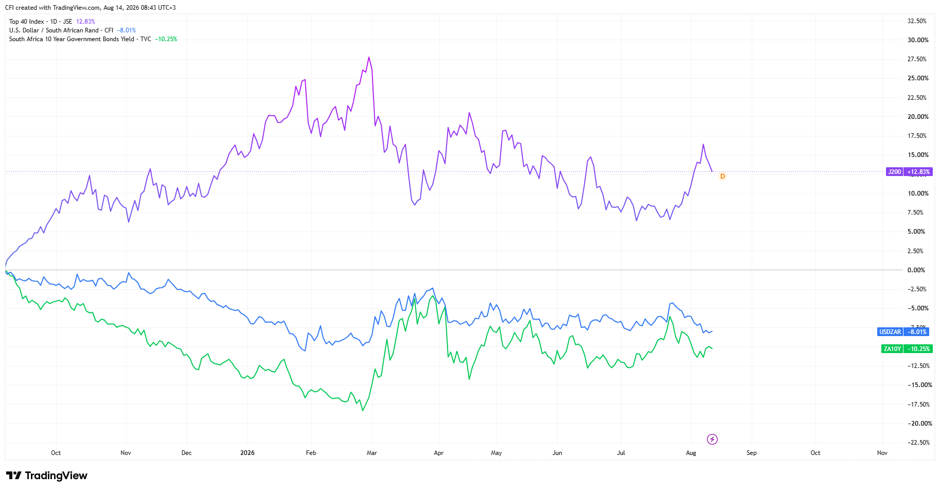 Figure 1: Purple (JSE Top 40), Blue (USD/ZAR), Green (SA 10Y Yield), Trading View
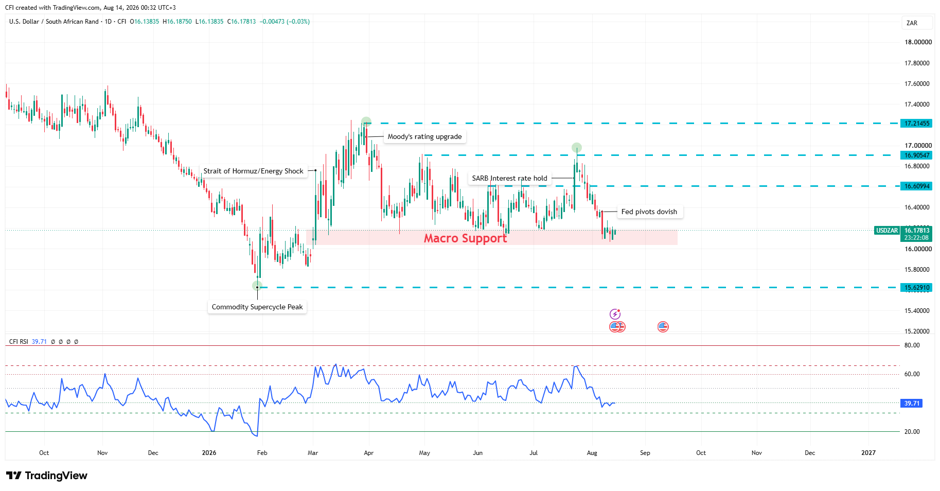 Figure 2: USDZAR, Daily, Trading View


-1786712547.webp)
-1724934015.webp)