Bonds
are one of the main instruments used by governments and companies to raise
capital. When an investor purchases a bond, they are essentially lending money
to the issuer for an agreed period. In return, the issuer generally pays
interest and repays the original amount when the bond reaches maturity.
Unlike
stocks, bonds do not represent ownership in a company. Bondholders are
creditors, meaning they have provided financing to the issuer rather than
purchased a share of the business.
How Do Bonds Work?
Governments
and companies regularly need capital to finance their activities. Governments
may require funding for public projects and expenditure, while businesses may borrow
to finance expansion, equipment, investment, or other corporate needs.
Issuing
bonds provides another way of obtaining this funding.
When
a bond is issued, several conditions are established in advance. These normally
include the amount that will eventually be repaid, the interest paid to
investors, and the date on which the bond matures. Many bonds can also be
traded after they are issued, meaning investors do not necessarily have to keep
them until maturity.
For
example, consider an investor purchasing a bond with a face value of $1,000 and
a coupon rate of 5%. This would represent $50 in annual interest. At maturity,
the investor would normally receive the $1,000 face value back, assuming the
issuer meets its payment obligations.
Key Bond Characteristics
There
are several important terms investors should understand when looking at bonds.
Face
Value: This is the amount the issuer is expected to repay
when the bond matures. It is also generally the amount used to calculate coupon
payments.
Coupon
Rate: The coupon rate determines the interest paid on the
bond relative to its face value.
Coupon
Date: This refers to the scheduled dates when interest
payments are made to bondholders.
Maturity
Date: The maturity date marks the end of the bond's term,
when the issuer is expected to repay its face value.
Issue
Price: This is the price at which the bond is initially
offered to investors. While many bonds are initially issued close to their face
value, their market price can later change.
Why Do Bond Prices Change?
Once
bonds begin trading in the secondary market, their prices can move according to
supply and demand as well as changes in interest rates, the issuer's
creditworthiness, and the time remaining until maturity.
One
of the most important principles to understand is that bond prices and market
interest rates generally move in opposite directions.
When
interest rates rise, previously issued bonds with lower coupons can become less
attractive compared with newly issued bonds offering higher rates. As a result,
the market price of the older bond may fall.
When
interest rates decline, the opposite can occur. Existing bonds offering
relatively higher coupons may become more attractive, which can push their
prices higher.
In
simple terms:
Interest
rates rise → Bond prices generally fall
Interest
rates fall → Bond prices generally rise
The relationship between Bond Price and yield.
This
relationship is particularly important during periods when central banks are
changing monetary policy.
Understanding Bond Yields
While
the coupon rate tells investors the interest paid relative to a bond's face
value, the yield provides another perspective on the return offered by the
bond.
Because
bonds can trade above or below their original value, the return available to a
new investor can differ from the stated coupon rate.
A
commonly followed measure is Yield to Maturity | YTM. It represents the
estimated annualized return from purchasing a bond at its current market price
and holding it until maturity, assuming the scheduled payments are made.
This
also helps explain why bond prices and yields move inversely. When a bond's
market price falls, its yield generally rises. When its price rises, its yield
generally falls.
Main Types of Bonds
Bonds
can also be classified according to who issues them.
Corporate
Bonds: Companies can issue bonds to raise debt financing instead of relying
entirely on bank borrowing or issuing additional shares.
Government
Bonds: National governments issue debt to finance their spending and funding
requirements. In the United States, Treasury securities include Treasury bills,
notes, and bonds, with their classification largely determined by maturity.
Municipal
Bonds: These are issued by states, cities, and other local government entities.
Agency
Bonds: Certain government-related organizations can also issue bonds to raise
financing.
Different Bond Structures
Not
every bond follows the traditional structure of regular coupon payments
followed by principal repayment.
Zero-coupon
bonds do not make regular coupon payments. Instead, they are typically sold
below their face value, with the investor's return coming from the difference
between the purchase price and the amount received at maturity.
Convertible
bonds provide investors with the possibility of converting the debt into
company shares under specified conditions.
Callable
bonds allow the issuer to repay the bond before its scheduled maturity under
certain terms.
Puttable
bonds, meanwhile, can provide the investor with the right to sell the bond back
to the issuer before maturity under specified conditions.
Credit Risk and Bond Ratings
The
financial strength of the issuer is another important consideration.
Credit-rating
agencies assess the ability of issuers to meet their debt obligations.
Higher-quality debt is generally classified as investment grade, while bonds
with lower credit ratings may be classified as high yield.
Higher-risk
issuers generally need to offer investors greater potential returns to
compensate for the additional possibility of default.
What Is Bond Duration?
Duration
helps investors understand how sensitive a bond's price may be to changes in
interest rates.
It
should not be confused with maturity. Maturity tells investors when the bond is
scheduled to be repaid, while duration is commonly used to assess its
interest-rate sensitivity.
Generally,
bonds with longer maturities and lower coupons tend to be more sensitive to
changes in market interest rates.
Why Are Bonds Important for Traders?
Bonds
are not only relevant to fixed-income investors. Bond-market movements can
provide important signals about expectations for interest rates, inflation,
economic growth, and monetary policy.
Government
bond yields, example: U.S. Treasury yields, are closely monitored across global
markets.
Changes
in yields can influence currencies, equities, commodities, and borrowing
conditions. For example, changing expectations for Federal Reserve policy can
quickly affect Treasury yields, which may then influence the US dollar, gold,
and equity valuations.
For
traders, understanding bonds therefore provides another way to interpret
changes in the broader market environment.
Conclusion
Bonds
allow governments and companies to obtain financing directly from investors. In
exchange, investors receive the contractual payments associated with the bond
and, provided the issuer meets its obligations, repayment of the principal at
maturity.
However,
a bond's value can change throughout its lifetime. Interest rates, credit
quality, maturity, market conditions, and investor expectations can all
influence its price and yield.
Understanding
these relationships is particularly useful because the bond market often
reflects changing expectations about the economy and monetary policy. For this
reason, bonds and yields remain important indicators even for traders focused
primarily on currencies, commodities, or equities.
Disclaimer: The content published above has been prepared by CFI for informational purposes only and should not be considered as investment advice. Any view expressed does not constitute a personal recommendation or solicitation to buy or sell. The information provided does not have regard to the specific investment objectives, financial situation, and needs of any specific person who may receive it, and is not held out as independent investment research and may have been acted upon by persons connected with CFI. Market data is derived from independent sources believed to be reliable, however, CFI makes no guarantee of its accuracy or completeness, and accepts no responsibility for any consequence of its use by recipients.





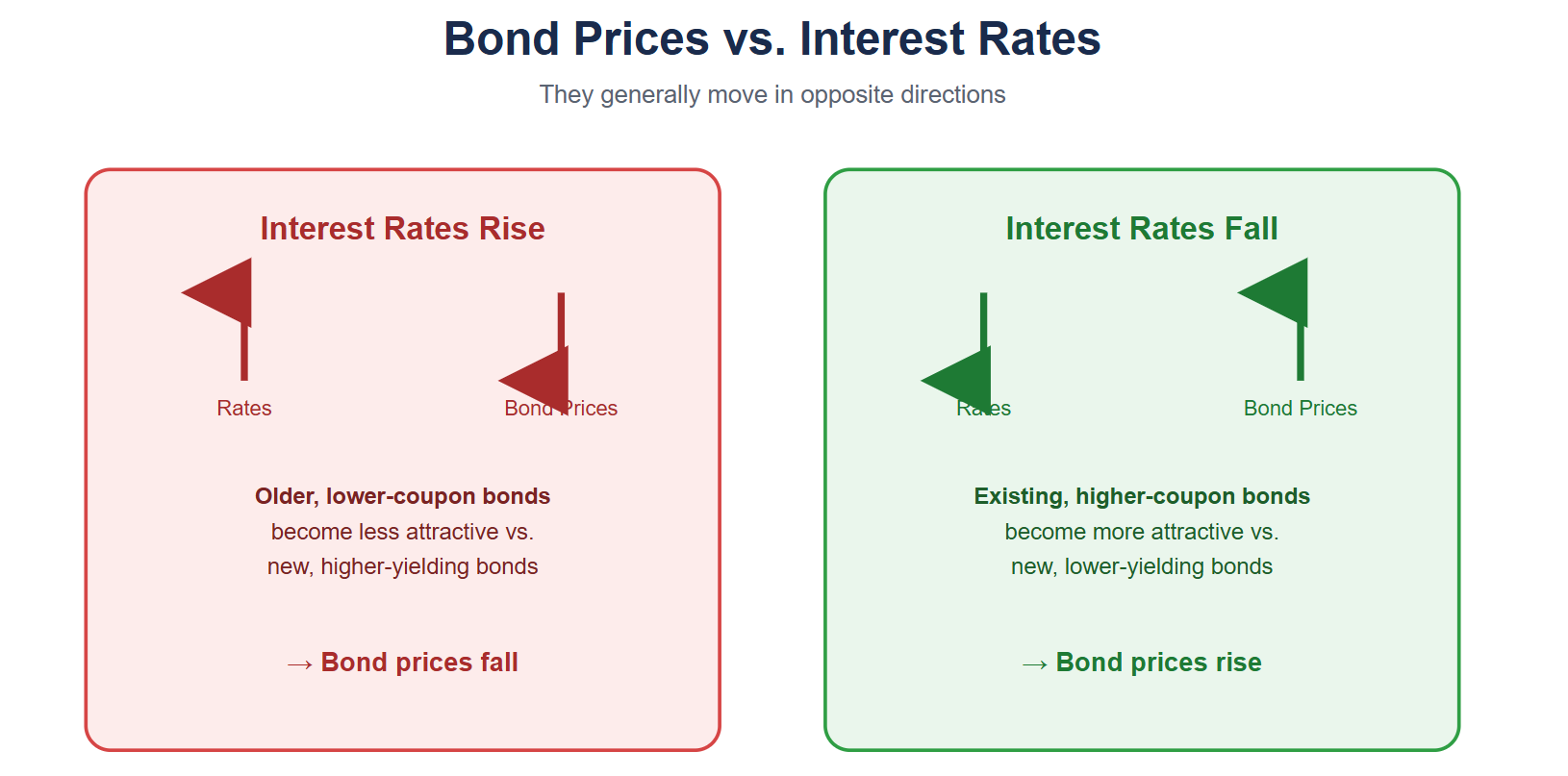 The relationship between Bond Price and yield.



-1763114932.webp)